

Thailand’s Hidden Food Capital. While Bangkok and Chiang Mai often hog the culinary spotlight, savvy food travelers in 2026 are turning their compasses toward a coastal province just two hours south of the capital.
Welcome to Phetchaburi, a city so rich in gastronomic heritage that it was officially designated a UNESCO Creative City of Gastronomy.
Known as the “City of Three Tastes”—salty from its sea salt farms, sweet from its legendary palm sugar, and sour from its local limes—Phetchaburi offers a flavor profile that is distinct from anywhere else in Thailand.
In this guide, we explore the winding alleys and riverside stalls of Thailand’s hidden food capital to discover the eats you cannot miss.
The Secret Ingredient: Phetchaburi Palm Sugar
To understand Phetchaburi food, you must understand the Toddy Palm. As you drive into the province, you will see thousands of palm trees swaying over emerald rice fields. The sap from these trees is simmered in large woks to create Nam Tan Tanot (palm sugar), a sweetener with a deep, smoky, and almost buttery complexity. This sugar is the backbone of the city’s culinary identity, balancing the heat of its curries and defining its world-famous desserts.
1. Khanom Jin Thot Man: The Ultimate Local Breakfast
While most of Thailand eats Thot Man Pla (fried fish cakes) as a snack with cucumber relish, Phetchaburi has a unique way of serving it: over a bed of Khanom Jin (fresh fermented rice noodles).
- The Experience: Head to the stalls near the Phetchaburi Governor’s House in the morning. You’ll receive a plate of silky white noodles topped with chewy, herb-heavy fish cakes and a generous dousing of sweet and spicy sauce.
- Why it Works: The coolness of the noodles perfectly offsets the warmth of the fried fish, and the local sauce—thickened with that signature palm sugar—ties the dish together.
- 2026 Update: Many stalls now offer a “Modern Mix” where you can add crispy fried basil and local river shrimp to the plate for an extra layer of texture.
2. Khao Chae: A Royal Refreshment
Phetchaburi was a favorite summer retreat for King Rama IV and Rama V, and they brought with them the tradition of Khao Chae. Originally a Mon dish, it was refined in the royal court and eventually filtered down to the local markets.
- The Dish: This is a seasonal delicacy of rice soaked in jasmine-scented ice water, served with a variety of side dishes like stuffed shallots, shredded sweetened pork, and deep-fried shrimp paste balls.
- The Phetchaburi Twist: Unlike the expensive versions found in Bangkok hotels, Phetchaburi’s Khao Chae is incredibly affordable and widely available in the Khao Wang Market. It is the ultimate “slow food” meant to be eaten during the heat of the afternoon.
3. Kuay Tiew Nam Daeng: The Red Soup Secret
If you see a bowl of noodles in Phetchaburi with a vibrant reddish broth, don’t be alarmed—it’s not just chili. This is Kuay Tiew Nam Daeng, a local specialty influenced by Chinese techniques but localized with Phetchaburi ingredients.
- The Secret: The red tint comes from a unique fermented red tofu (fermented bean curd) and a heavy dose of local palm sugar.
- The Condiment: Here is the golden rule: people in Phetchaburi do not use standard vinegar. Instead, they use locally fermented chili sauce, which is bright, acidic, and carries a fermented kick that cuts through the rich pork broth.
- Where to find it: Look for the “Blue Door” noodle shop near the riverside for a bowl that has remained unchanged for three generations.
4. Kaeng Kua Hua Tan: The Heart of the Palm
One of the most authentic dishes of the province is Kaeng Kua Hua Tan, a thick, coconut-based curry made from the tender tops of young toddy palms.
- The Flavor Profile: The palm heart has a slightly bitter, nutty taste that is mellowed out by the creamy coconut milk and a spicy curry paste. Usually, this is cooked with grilled fish or succulent pork belly.
- Cultural Significance: This dish is a testament to the “zero waste” philosophy of Phetchaburi’s ancestors—every part of the palm tree is used, from the sap for sugar to the fruit for dessert and the heart for curry.
5. The “Sugar Capital” Desserts: Khanom Maw Kaeng
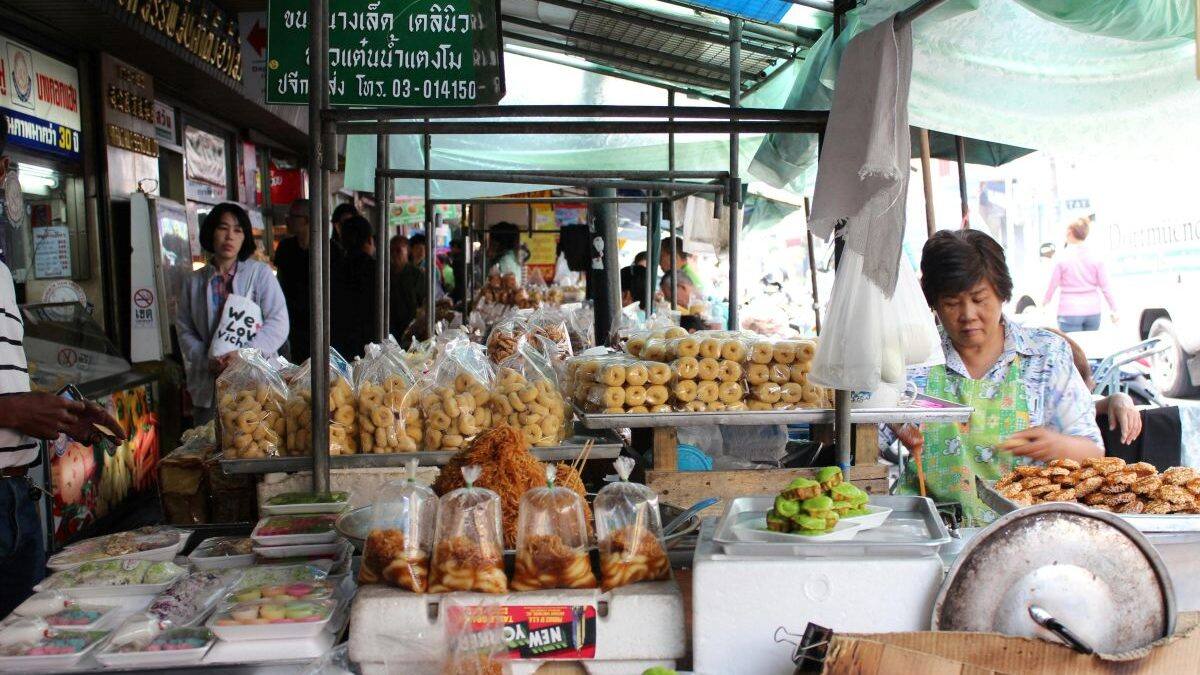
You cannot leave Phetchaburi without a box (or five) of Khanom Maw Kaeng. This is a Thai custard made from eggs, coconut milk, and—you guessed it—palm sugar.
- The Phetchaburi Difference: While you can find this custard across Thailand, Phetchaburi’s version is topped with fried shallots, giving it a savory aroma that balances the sweetness. In 2026, local artisanal shops like Mae Kim Lung have introduced new variations, including macadamia-topped custard and durian-infused palm sugar cakes.
- The Palm Seed Snack: Also try Luk Tan Sot, the fresh, jelly-like seeds of the toddy palm served in a light syrup. It is the most refreshing snack you will find in the province.
Exploring the Riverside Street Food Scene (Night Market)
As the sun sets over Phra Nakhon Khiri (Khao Wang), the area around the clock tower transforms into a bustling food street. In 2026, the night market has expanded to include “Gastronomy Walking Tours” where local students act as guides to explain the history of the dishes.
- Pad Thai Phetchaburi: Unlike the Bangkok version, it is often cooked with a base of palm sugar and local limes, giving it a much brighter and more caramelized flavor.
- Fresh Seafood: Being a coastal province, the grilled squid and cockles here are incredibly fresh, served with a dipping sauce that highlights the local salt and lime.
Why Phetchaburi is the “Hidden” Capital
Phetchaburi remains “hidden” because it sits in the shadow of Hua Hin, the popular resort town further south. Most travelers drive right through it, missing out on some of the most complex flavors in Southeast Asia. However, the UNESCO recognition has sparked a “Culinary Renaissance.” Young chefs are returning to their hometowns to open “Farm-to-Table” concepts that utilize the province’s salt, lime, and sugar in contemporary ways.
2026 Travel Tips for Foodies:
- Transport: The new high-speed rail link from Bangkok now stops in Phetchaburi, making it a perfect day-trip or a delicious weekend getaway.
- The “Three Tastes” Tour: Look for workshops in the Ban Lat district where you can see palm sugar being made over traditional wood fires before heading to the salt pans of Ban Laem.
- App-Based Ordering: Many of the legendary “grandma stalls” are now on local delivery apps, but nothing beats the experience of sitting on a wooden stool by the river.
Conclusion
Phetchaburi is a city that cooks with its heart and its history. It is a place where the sweetness of the palm, the sting of the lime, and the salt of the sea come together in a perfect, edible harmony. Whether you are slurping red-broth noodles or peeling back the leaf of a palm-sugar custard, you are tasting a UNESCO-certified heritage that has been perfected over centuries.
If you want to experience the true soul of Thai cuisine away from the tourist traps, Phetchaburi is waiting with an open kitchen and a steaming bowl of history.
About the Author


